Monomers for functional polymers
Chloromethyl styrene (CMS)
Chemical name: Chloromethyl styrene
Another name: Vinylbenzyl chloride
CMS is a highly responsive monomer having vinyl and chloromethyl groups in molecules. Because of degree of freedom of application of the responsive (difunctional) monomer, it is used for various purposes as a raw material of high molecular modifiers such as rubber and resin, photographic materials, coupling agents, and various other treatment agents. Furthermore, possibility of a new CMS derivative is infinitely expanding in various fields.
Physical Properties of CMS
| Appearance | Slighty yellow transparent liquid (coloring with a polymerization inhibitor) |
|
|---|---|---|
| Molecular Weight | 152.62 | |
| Boiling point | 229 to 240℃ | |
| Freezing point | -15.5℃ | |
| Specific gravity(25℃) | 1.09 to 1.10 | |
| Viscosity cps(25℃) | 1.8 to 1.9cps | |
| Refraction index nD25 | 1.57 | |
| Surface tension | 38m N/m | |
| Solubility | H2O inCMS | 0.07g/l |
| CMS inH2O | 0.6g/l | |
| Flash point(CMS-14) | 107(108℃) | |
CMS has two types of isomeric forms – meta isomer and para isomer. As the products, there are two product types: CMS-P which is a mixture of meta and para isomers and CMS-14 which mainly consists of para isomer.
Chemical Properties of CMS
| CMS-P | CMS-14 | ||
|---|---|---|---|
| Purity | CMS | 95% or more | 95% or more |
| Impurities | ∀-chloromethyl styrene dichloro-form |
2% or below 2% or below |
2% or below 2% or below |
| Isomer ratio | Meta Para |
45 to 55 45 to 55 |
5 95 |
Reactivity of CMS
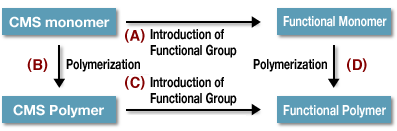
CMS has two reactive groups - vinyl and chloromethyl groups - and can induce high functionality, high molecules in two ways.
(1)One way is to obtain functionality high molecules by making monomers’ chloromethyl group react and, after obtaining functionality monomers, polymerizing them (A → D).
(2)Another way is, after CMS is polymerized, to induce functionality high molecules by polymer reaction (B → C). Both reactions easily progress.
In these ways, the processes of obtaining functionality high molecules by using CMS as the starting material can be selected according to purposes.
Application of CMS
Ion-exchange membrane, silane coupling agent, resin modifier, rubber modifier, photographic material, photosensitive material, etc
Legal matters
United Nations classification : Class 6.1
United Nations number : 2810
Packing Group : P.GⅢ
Act on the Evaluation of Chemical Substances and Regulation of Their Manufacture, etc : 3-46
Fire Service Act : Hazardous material, fourth group,third class petroleum (non-water-soluble material)
CAS NO, : 30030-25-20(CMS-P),1592-20-7(CMS-14)